
Image Generation


For Van de Velde’s premium brands, Visual AI opens up a controlled way to extend existing packshots and marketing imagery for new colour variants, without replacing the role of physical photoshoots.



Van de Velde needs thousands of product images for its international retailer network, own retail chains and its premium brands Marie Jo, Primadonna and Sarda. When successful lines get new colour variants, the group explored whether AI could extend existing photography in a controlled, high-quality way.
The result is a custom Visual AI pipeline that reuses existing photo shoot material to create hyperrealistic packshots and lifestyle images, specifically for variants of existing products.

1
More than 750 hyperrealistic images were generated from existing product photography at master resolution.
2
The custom Visual AI pipeline went from R&D to production in just 10 weeks.
3
Van de Velde can manage a scalable recolouring process while maintaining brand consistency and quality standards.
The project started with an R&D phase and a proof of concept to test whether existing packshots and marketing images could be adapted to new colours, fabrics and textures while meeting Van de Velde’s quality standards, with particular attention to ethical AI use and quality control.
The resulting pipeline combines open-source and custom-trained AI models, specific parameters and multiple processing steps with QA gates. Models are trained for specific recolouring tasks and tuned to the level of detail required for premium product imagery, while the pipeline is adapted to Van de Velde’s existing way of working. The approach puts control, transparency, adaptability and privacy first.
Importantly, the pipeline does not replace photo shoots. It provides a targeted way to extend existing photography with colour variants of proven products, while respecting the look, feel and quality standards of each brand.
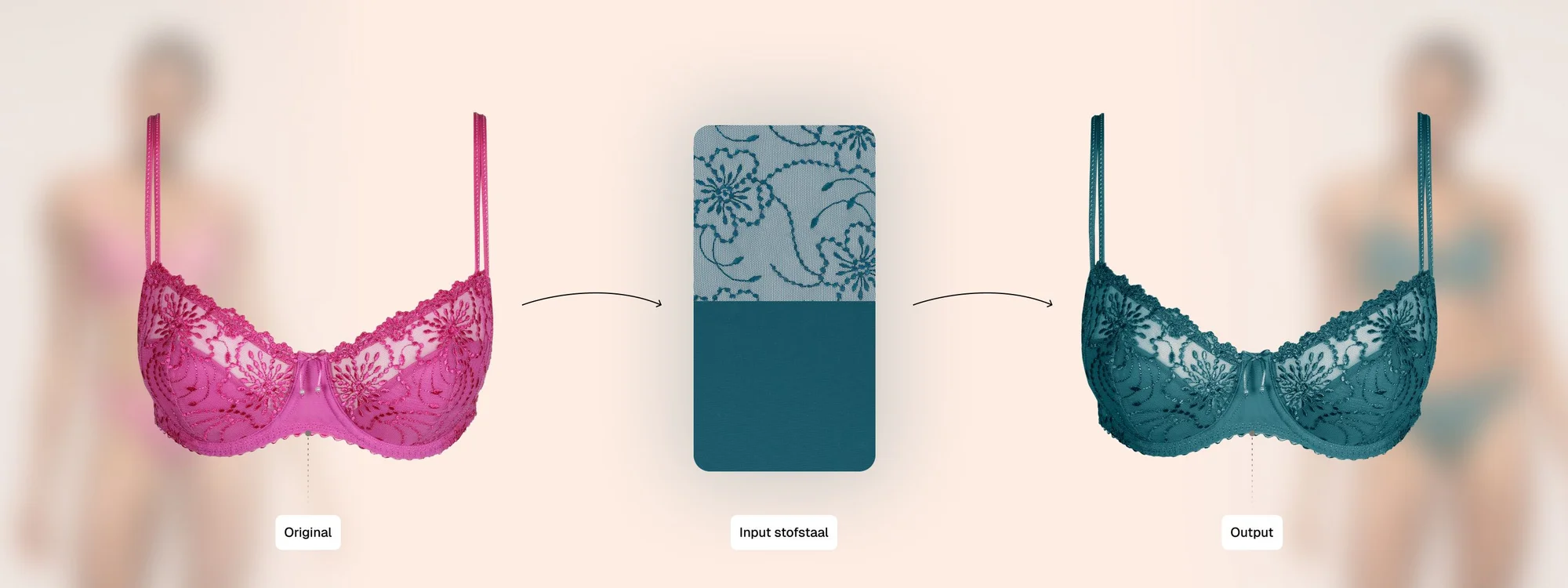
Within 10 weeks, the project moved from R&D to a production-ready pipeline. More than 750 images were generated at master resolution, with Van de Velde managing the scalable capacity itself within its existing quality process.
Alongside the technology, the project also included advice on where Visual AI adds the most value and how generated imagery can fit into existing workflows while keeping quality and governance under control.